Piedmont Driving Club
A Man in FullThe Piedmont Driving Club is more than a private social venue in Atlanta: it is a visible emblem of elite belonging, a place whose history and membership expose the city’s racial boundaries, and a recurring setting where personal standing becomes political leverage. From a terrace overlooking a Freaknik street party to the rooms where Charlie Croker confronts the strains on his wealth and friendships, the club gives social hierarchy a physical address.
Setting and Origins
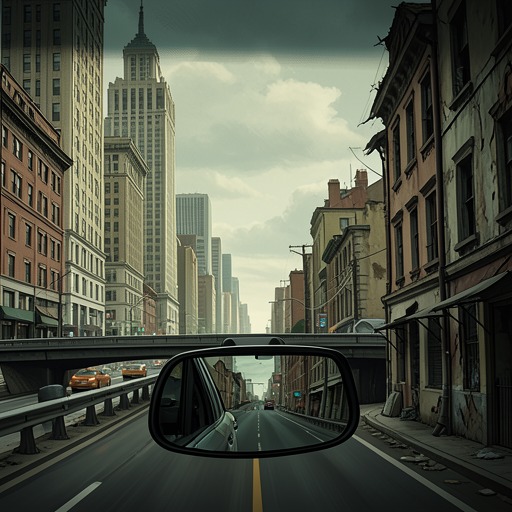
The club stands on high ground beside Piedmont Park. A white fence and stone pillars mark the approach up the hill, while the building itself is difficult to take in from the driveway. From the street below, its terrace provides a clear vantage over Piedmont Avenue, placing the club physically above the public bustle around it.
The institution began in 1887, twenty-two years after the Civil War, when Atlanta’s white elite gathered on weekends in what is now Piedmont Park to display their carriages, custom vehicles, harnesses, and expensive horses. The gatherings made conspicuous consumption part of the club’s original purpose. Members eventually acquired a clubhouse, enlarged it over time, and built an establishment whose history is legible in its accumulating architecture. The club’s origins thus join leisure to display: its members did not merely travel in fine vehicles but assembled to be seen doing so.
The original clubhouse was a farmhouse of rusticated brick and stone. After fires and successive rebuilding and expansion, the complex spread across the hillside in stages. Its main entrance and porte cochere are relatively modest, but the interior opens into much grander spaces. Some of the most imposing rooms, including the lobby and ballroom, bear the mark of Atlanta architect Philip Shutze. The result is less a single, unified monument than a rambling structure whose layers of additions embody the club’s long continuity. In a city where a building dating to 1887 counts as ancient, that accumulated past is itself part of its prestige.
An Enclave and Its Racial Boundaries
For much of its history, Black people entered the club only as workers: cooks, dishwashers, waiters, doormen, attendants, and other service staff. By the time of the novel, the club had begun seeking Black members, but that change does not erase the boundary represented by its terrace. The building remains a citadel of the white Atlanta establishment in the eyes of Roger Too White, who understands both the significance of an invitation and the terms on which it is offered.
During a Freaknik traffic jam, Roger Too White sees formally dressed white guests peering down from the terrace at the Black crowds filling the street and gathering in Piedmont Park. The revelers dance among their cars, laugh, shout, and turn their attention toward the onlookers. One woman on top of a Camaro points up at the club; the crowd follows her gesture and performs for the terrace, transforming the club’s elevated position into the focus of a good-natured public mockery. The scene reverses the old spectacle of elite display. Instead of the club’s members exhibiting vehicles and status to one another, the crowd below makes its own exuberance impossible to ignore.
Roger Too White reads the confrontation through the club’s history. He recognizes the irony of a traffic jam on Piedmont Avenue outside an institution founded around showing off vehicles, and he sees the Black crowd’s presence as a challenge to a space that had excluded Black people except as employees. Yet his response is divided. He imagines leaving his Lexus, joining the street, and confronting the guests, but does not get out of the car. He has an appointment with Coach Buck McNutter and remains conscious of the white authority attached to that meeting. The contrast between the public spectacle below and the still, formal guests above sharpens the limits of Roger Too White’s own defiance: he can read the scene clearly without becoming its public participant.
The club’s changing membership policy also carries an uneasy implication. Roger Too White has received an approach from Buddy Lee Witherspoon, but regards the invitation as evidence of how white people perceive him as unusually assimilated, not as proof that the institution’s history has been overcome. He rejects the prospect of joining and circulating on the terrace. The club can reach toward a new membership while remaining, in his view, a place whose invitation tests how much of the old order a prospective member is willing to accept.
Status, Access, and Charlie Croker
For Charlie Croker, the club’s importance is difficult to dismiss even when he tries to tell himself that it does not matter. He believes that Martha’s Richmond background helped him gain entry; in Atlanta, her origins carry a kind of social authenticity. He also recognizes that exclusion would have provoked his resentment. A man might possess a grand Buckhead house, a private jet, or other costly possessions and still feel the club’s absence as a reproach. Its power rests not only on what members do there but on the status conveyed by being admitted to its roster.
That standing is sustained by a network of relationships and rituals. Charlie’s familiarity with the club places him among Atlanta’s well-connected social set, but the setting does not insulate him from financial trouble. At the Mayflies Ball, he arrives with Serena in his Ferrari while his right knee is painful enough to make braking difficult. He tries to rise from the car without exposing his infirmity to the club members entering through the main door, only to fall back into the seat. The carefully managed arrival that he hoped would preserve his dignity instead makes the failing body that he wanted to conceal part of the evening’s reality.
Inside, the club’s elaborate rooms intensify the contrast between social ease and private distress. The lobby’s plasterwork and the ballroom’s vaulted ceiling, colonnades, arches, and garlands frame a gathering of tuxedos, evening clothes, handshakes, and laughter. Charlie worries that other guests know PlannersBanc has taken his G-5 and will see him as a ruined man who dares to appear. Arthur Lomprey, the bank’s president, is present, but does not confront him about the loan in the lobby. Even among people who might know of his predicament, the club’s social conventions temporarily keep the conflict beneath the surface.
The evening also brings personal history into the same rooms as public standing. Charlie sees Serena speaking privately with Elizabeth Armholster in the Bamboo Room and Inman Armholster among the guests. He tries to avoid Inman, conscious of what he knows about Elizabeth and of the danger of appearing to disregard his friend’s feelings. Inman summons him, and they later sit together in the ballroom. The club is therefore not merely a backdrop to Charlie’s status anxiety: it gathers the people and obligations that make his public choices costly.
A Stage for Political Calculation
The club’s reputation makes it useful well beyond its social calendar. When Wesley Dobbs Jordan explains that he needs a prominent white supporter to speak in favor of withholding judgment in the case involving Fareek Fanon, he rejects Herbert Richman as the wrong kind of representative for his purpose. He wants someone associated with the real establishment, someone whose standing is linked to the Piedmont Driving Club. He names Charlie Croker. The club’s symbolic authority thus becomes a political resource: the desired endorsement is valuable in part because it would come from a man legible to the city’s elite.
Wesley Dobbs Jordan’s connection to the club is itself complicated. He tells Roger Too White that he was quietly invited to join but does not want membership, even though he has his eye on someone who belongs there. The club can be both an object of political knowledge and a space a politician chooses not to enter. In the conversation, Roger Too White recounts the Freaknik scene, including the crowd’s mockery of the formal party on the terrace; the contrast between that memory and Wesley Dobbs Jordan’s account of his invitation underscores how differently the same institution can register for people navigating Atlanta’s racial and political order.
Charlie’s eventual decision to support a public appeal for restraint is bound up with his debt crisis, his ties to Inman, and the prospect of losing his standing among the club set. When he explains the proposed bargain to Serena, he recounts how Roger White offered relief from PlannersBanc’s bankruptcy machinery in exchange for a favorable public statement about Fareek Fanon. Charlie considers the consequences on both sides: speaking could preserve his possessions while damaging his relationships with Inman and other friends; refusing could cost him his property without saving those relationships. In his thoughts, the club becomes a measure of the social world he might lose, not simply an address where he dines.
The pressure also makes the club a place of imagined exposure. After Charlie’s Cherokee County dealings are revealed, he fears that the disclosure could make it dangerous for him to cross the county line or even to appear at the Piedmont Driving Club. Later, as he weighs the proposed press conference, he pictures Arthur Lomprey at the club and wonders what the banker knows about the pressure that has eased against his holdings. These are private calculations rather than a new confrontation on the club’s grounds, but they show how thoroughly Charlie associates the institution with the people and judgments governing his survival.
Architecture, Memory, and Social Consequence
The Piedmont Driving Club’s significance comes from the way it joins physical elevation, historical memory, and access. Its hilltop terrace looks down on a changing city; its old building preserves the history of elite display; and its membership functions as a test of recognition that even immense wealth cannot make irrelevant. The contrast between the Freaknik crowd in the street and the formal guests above gives that hierarchy a striking public image, while Charlie’s later attendance reveals how much he still depends on the approval the club represents.
The setting also links private loyalties to public choices. Charlie and Inman meet there in the shadow of the allegation involving Elizabeth; Serena speaks with Elizabeth in the Bamboo Room; and Wesley Dobbs Jordan identifies Charlie’s establishment standing as an asset in a racially charged political crisis. The club does not resolve these conflicts. Instead, its rooms bring them into proximity, while its social prestige gives them consequences. It is at once a landmark, a gatekeeping institution, and a measure of how vulnerable status becomes when money, reputation, and friendship begin to fail together.